
Reverberation in gymnasia
Keywords:
architectural acoustics, reverberation, acoustical environment, public school gymnasia, Mississauga area, reverberation time, early/late arrival ratios, subjective opinions, building code implicationsAbstract
Gymnasia for public use are constructed and renovated on a regular basis, but the acoustical results are not always satisfactory or consistent. This paper examines this situation by presenting and discussing two case studies. In the first study, measurements of reverberation inside five public school gymnasia were carried out in the Mississauga area. The gymnasia were all geometrically alike, and had been constructed from typical building materials. Four of the gymnasia had been acoustically treated and were considered by the teaching staff of each to provide an adequate acoustical environment for typical activities. The remaining gymnasium was acoustically untreated, and its acoustic environment was considered by the staff to seriously impede its use. A brief literature review conducted to determine criteria specific to gymnasia revealed a notable lack of published information, both in terms of the traditional descriptor, the reverberation time (RT60), and in terms of more recently developed descriptors based on early/late arrival ratios. The measurement results and the subjective opinions expressed by each school's staff were used to determine reverberation criteria for a gymnasium, and to investigate the effectiveness of typical control measures. A second similar case study is presented. The results are discussed in terms of the relevance of various descriptors and potential building code implications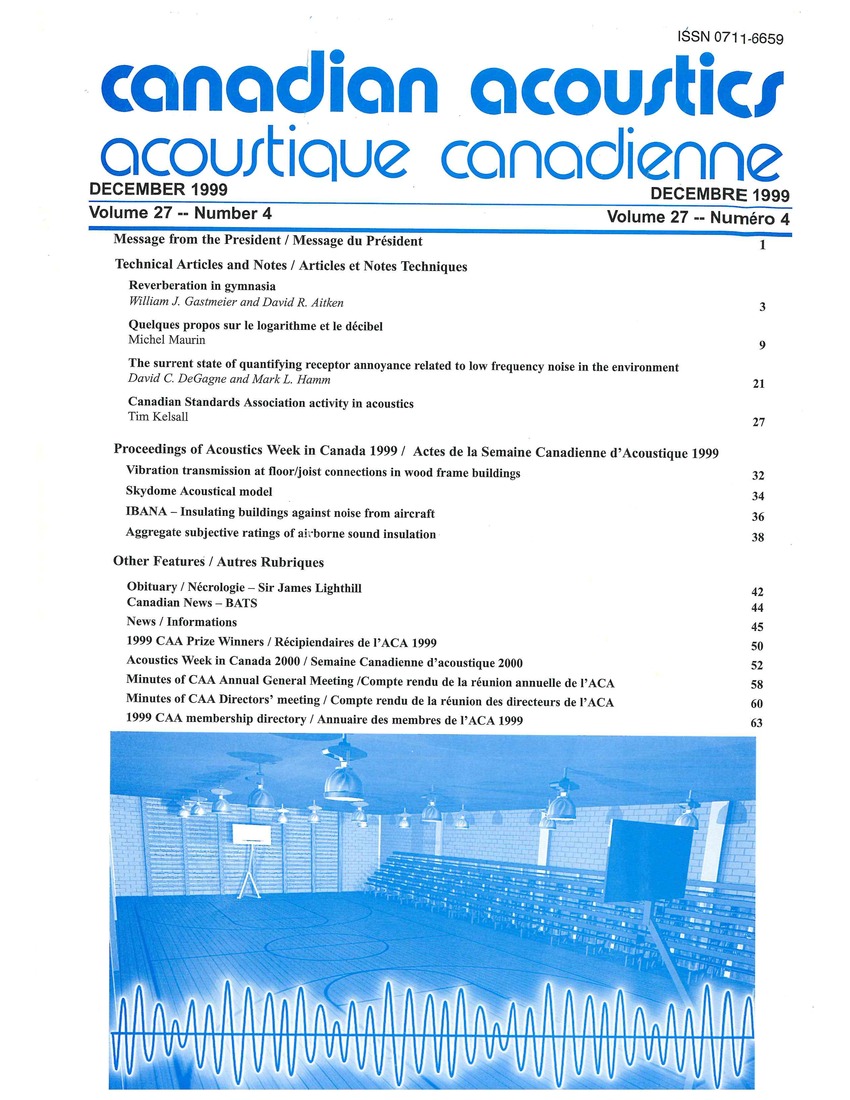
Additional Files
Published
How to Cite
Issue
Section
License
Author Licensing Addendum
This Licensing Addendum ("Addendum") is entered into between the undersigned Author(s) and Canadian Acoustics journal published by the Canadian Acoustical Association (hereinafter referred to as the "Publisher"). The Author(s) and the Publisher agree as follows:
-
Retained Rights: The Author(s) retain(s) the following rights:
- The right to reproduce, distribute, and publicly display the Work on the Author's personal website or the website of the Author's institution.
- The right to use the Work in the Author's teaching activities and presentations.
- The right to include the Work in a compilation for the Author's personal use, not for sale.
-
Grant of License: The Author(s) grant(s) to the Publisher a worldwide exclusive license to publish, reproduce, distribute, and display the Work in Canadian Acoustics and any other formats and media deemed appropriate by the Publisher.
-
Attribution: The Publisher agrees to include proper attribution to the Author(s) in all publications and reproductions of the Work.
-
No Conflict: This Addendum is intended to be in harmony with, and not in conflict with, the terms and conditions of the original agreement entered into between the Author(s) and the Publisher.
-
Copyright Clause: Copyright on articles is held by the Author(s). The corresponding Author has the right to grant on behalf of all Authors and does grant on behalf of all Authors, a worldwide exclusive license to the Publisher and its licensees in perpetuity, in all forms, formats, and media (whether known now or created in the future), including but not limited to the rights to publish, reproduce, distribute, display, store, translate, create adaptations, reprints, include within collections, and create summaries, extracts, and/or abstracts of the Contribution.