
Mandarin listeners' perception of english vowels: Problems and strategies
Keywords:
Acoustics, Problem solving, Sensory perception, Speech analysis, English vowels, Vowel perceptionAbstract
Previous research suggests L2 vowel perception problems are often due to the assimilation of L2 sounds to L1 categories. However, there is also evidence for a universal strategy which states listeners will rely on duration cues whenever spectral cues are not sufficient for discriminating L2 vowel contrasts. This study examines Mandarin listeners' perceptual problems with English vowels. In a perception test, a group of adult Mandarin-English bilinguals residing in Canada identified synthesized English /i/-/I/, /u/-/?/, and /æ/-/?/ continua that manipulated vowel spectral and duration cues. Compared with a native English group who responded exclusively to the spectral cues, the majority of native Mandarin listeners failed to show native-like perceptual patterns for the three vowel contrasts. However, they responded heavily and consistently to duration cues for the /i/-/I/ but not for the /u/- /?/ and /æ/-/?/ contrasts. Both group and individual data suggest that native Mandarin listeners used different strategies in perceptual identification of L2 vowel contrasts. Most Mandarin listeners did not appear to have clear category distinctions for /u/-/?/ and /æ/-/?/ pairs and some established incorrect perceptual representation of the /i/-/I/ contrast. The findings did not fully support the universal strategy of using duration cues when non-native vowel contrasts are difficult to perceive.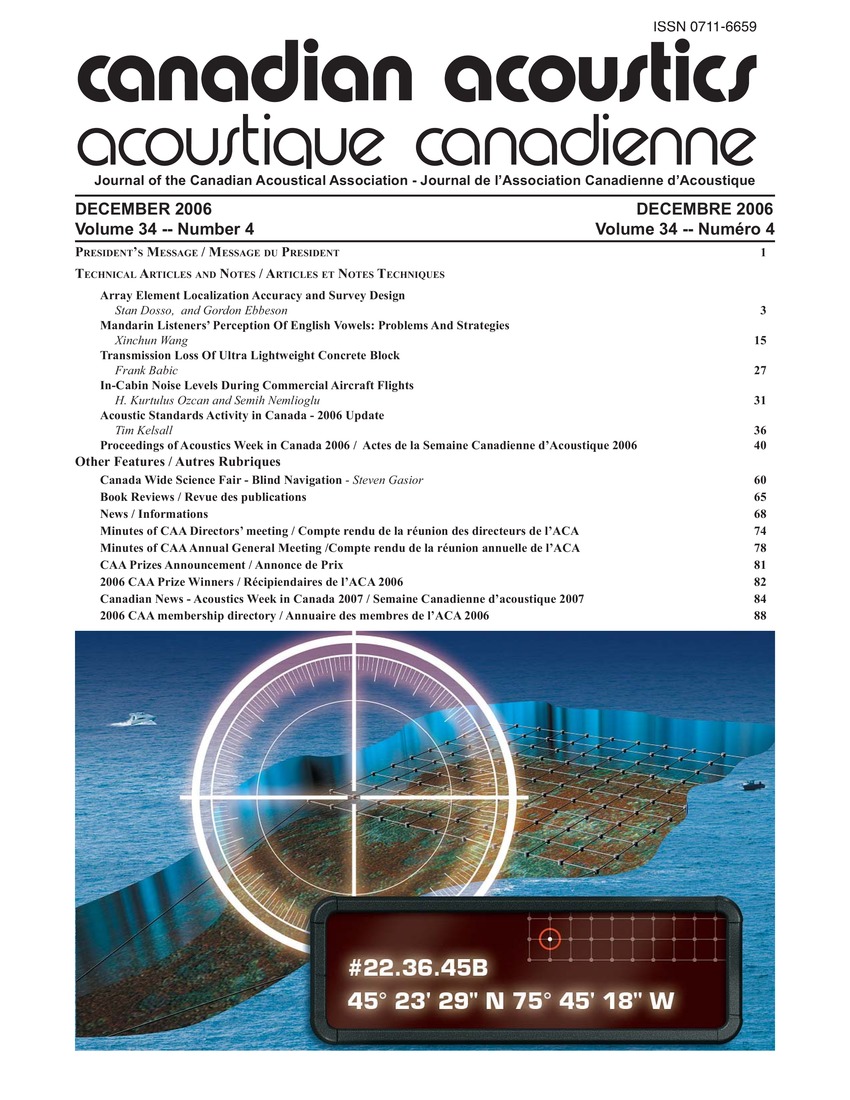
Additional Files
Published
How to Cite
Issue
Section
License
Author Licensing Addendum
This Licensing Addendum ("Addendum") is entered into between the undersigned Author(s) and Canadian Acoustics journal published by the Canadian Acoustical Association (hereinafter referred to as the "Publisher"). The Author(s) and the Publisher agree as follows:
-
Retained Rights: The Author(s) retain(s) the following rights:
- The right to reproduce, distribute, and publicly display the Work on the Author's personal website or the website of the Author's institution.
- The right to use the Work in the Author's teaching activities and presentations.
- The right to include the Work in a compilation for the Author's personal use, not for sale.
-
Grant of License: The Author(s) grant(s) to the Publisher a worldwide exclusive license to publish, reproduce, distribute, and display the Work in Canadian Acoustics and any other formats and media deemed appropriate by the Publisher.
-
Attribution: The Publisher agrees to include proper attribution to the Author(s) in all publications and reproductions of the Work.
-
No Conflict: This Addendum is intended to be in harmony with, and not in conflict with, the terms and conditions of the original agreement entered into between the Author(s) and the Publisher.
-
Copyright Clause: Copyright on articles is held by the Author(s). The corresponding Author has the right to grant on behalf of all Authors and does grant on behalf of all Authors, a worldwide exclusive license to the Publisher and its licensees in perpetuity, in all forms, formats, and media (whether known now or created in the future), including but not limited to the rights to publish, reproduce, distribute, display, store, translate, create adaptations, reprints, include within collections, and create summaries, extracts, and/or abstracts of the Contribution.