
The benefits of field testing the acoustic performance of sound isolation rooms
Keywords:
architectural acoustics, noise abatement, acoustic performance, sound isolation rooms, auditory examination, noise reduction, background noise level, field testing, uniform test conditions, structureborne sound isolation, sound leakage pathsAbstract
Sound isolation rooms, typically used for auditory examination and research, are designed to provide a noise reduction in excess of ninety decibels and a background noise level approaching the auditory threshold. The noise reduction of these specialized rooms, as published by the various manufacturers, are usually laboratory tested in accordance with ANSI/ASTM E 596. Although methods of field testing these rooms have been proposed, there is no standardized procedure that allows the in-situ performance to be directly compared to the laboratory measurements. One main consideration is the physical environments surrounding a sound isolation room placed in a building, which varies greatly from the uniform test conditions of a reverberation chamber. Numerous sound isolation rooms were recently field-tested for their acoustic performance. Airborne sound isolation, background noise and structureborne sound isolation were investigated. For determining airborne sound isolation in the field, a simplified measure of noise reduction was used. Airborne sound leakage paths were clearly identified within the rooms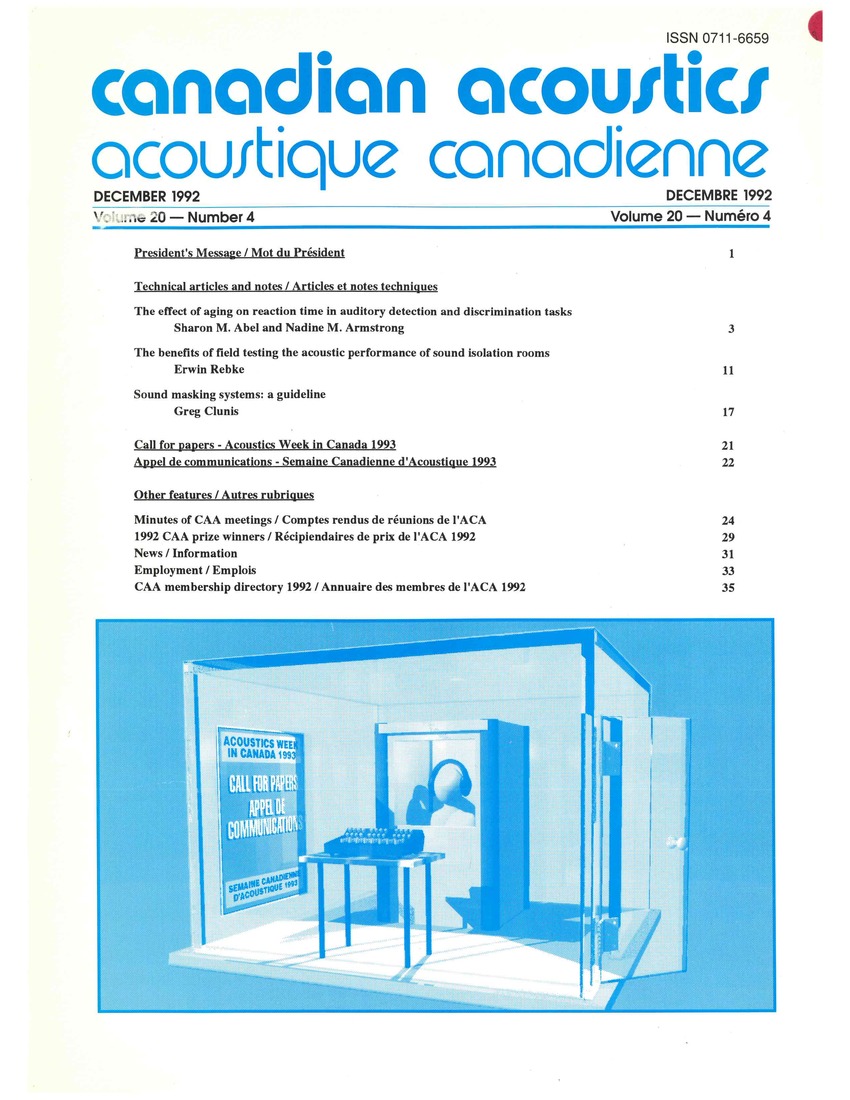
Additional Files
Published
How to Cite
Issue
Section
License
Author Licensing Addendum
This Licensing Addendum ("Addendum") is entered into between the undersigned Author(s) and Canadian Acoustics journal published by the Canadian Acoustical Association (hereinafter referred to as the "Publisher"). The Author(s) and the Publisher agree as follows:
-
Retained Rights: The Author(s) retain(s) the following rights:
- The right to reproduce, distribute, and publicly display the Work on the Author's personal website or the website of the Author's institution.
- The right to use the Work in the Author's teaching activities and presentations.
- The right to include the Work in a compilation for the Author's personal use, not for sale.
-
Grant of License: The Author(s) grant(s) to the Publisher a worldwide exclusive license to publish, reproduce, distribute, and display the Work in Canadian Acoustics and any other formats and media deemed appropriate by the Publisher.
-
Attribution: The Publisher agrees to include proper attribution to the Author(s) in all publications and reproductions of the Work.
-
No Conflict: This Addendum is intended to be in harmony with, and not in conflict with, the terms and conditions of the original agreement entered into between the Author(s) and the Publisher.
-
Copyright Clause: Copyright on articles is held by the Author(s). The corresponding Author has the right to grant on behalf of all Authors and does grant on behalf of all Authors, a worldwide exclusive license to the Publisher and its licensees in perpetuity, in all forms, formats, and media (whether known now or created in the future), including but not limited to the rights to publish, reproduce, distribute, display, store, translate, create adaptations, reprints, include within collections, and create summaries, extracts, and/or abstracts of the Contribution.