
Performance of spectrogram cross-correlation in detecting right whale calls in long-term recordings from the bering sea
Keywords:
Acoustic noise, Automation, Correlation methods, Hydrophones, Marine biology, Ocean habitats, Optimization, Signal detection, Bearing sea, Long-term recording, Spectrogram, Whale callsAbstract
We investigated the performance of spectrogram cross-correlation for automatically detecting North Pacific right whale (Eubalaena japonica) calls in long-term acoustic recordings from the southeastern Bering Sea. Data were sampled by autonomous, bottom-mounted hydrophones deployed in the southeastern Bering Sea from October 2000 through August 2002. A human analyst detected right whale calls within the first month (October 2000) of recorded data by visually examining spectrograms and by listening to recorded data; these manual detections were then compared to results of automated detection trials. Automated detection by spectrogram cross-correlation was implemented using a synthetic kernel based on the most common right whale call type. To optimize automated detection parameters, the analyst performed multiple trials on minutes-long and hour-long recordings and manually adjusted detection parameters between trials. A single set of optimized detection parameters was used to process a week-long recording from October 2000. The automated detector trials resulted in increasing proportions of false and missed detections with increasing data set duration, due to the higher proportion of acoustic noise and lower overall call rates in longer recordings. However, the automated detector missed only one calling "bout" (2 or more calls within a 10-minute span) of the 18 bouts present in the week-long recording. Despite the high number of false detections and missed individual calls, spectrogram cross-correlation was useful to guide a human analyst to sections of data with potential right whale calling bouts. Upon reviewing automatic detection events, the analyst could quickly dismiss false detections and search recordings before and after correct detections to find missed calls, thus improving the efficiency of searching for a small number of calls in long-term (months- to years-long) recordings.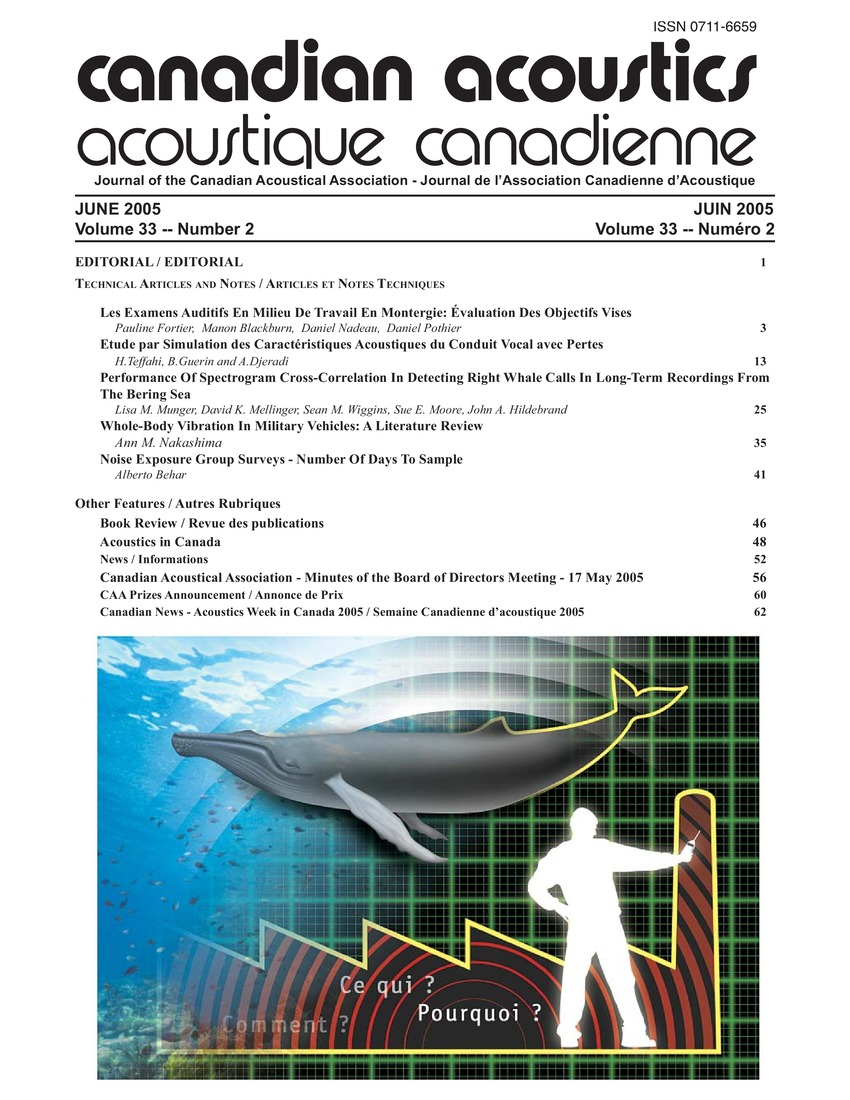
Additional Files
Published
How to Cite
Issue
Section
License
Author Licensing Addendum
This Licensing Addendum ("Addendum") is entered into between the undersigned Author(s) and Canadian Acoustics journal published by the Canadian Acoustical Association (hereinafter referred to as the "Publisher"). The Author(s) and the Publisher agree as follows:
-
Retained Rights: The Author(s) retain(s) the following rights:
- The right to reproduce, distribute, and publicly display the Work on the Author's personal website or the website of the Author's institution.
- The right to use the Work in the Author's teaching activities and presentations.
- The right to include the Work in a compilation for the Author's personal use, not for sale.
-
Grant of License: The Author(s) grant(s) to the Publisher a worldwide exclusive license to publish, reproduce, distribute, and display the Work in Canadian Acoustics and any other formats and media deemed appropriate by the Publisher.
-
Attribution: The Publisher agrees to include proper attribution to the Author(s) in all publications and reproductions of the Work.
-
No Conflict: This Addendum is intended to be in harmony with, and not in conflict with, the terms and conditions of the original agreement entered into between the Author(s) and the Publisher.
-
Copyright Clause: Copyright on articles is held by the Author(s). The corresponding Author has the right to grant on behalf of all Authors and does grant on behalf of all Authors, a worldwide exclusive license to the Publisher and its licensees in perpetuity, in all forms, formats, and media (whether known now or created in the future), including but not limited to the rights to publish, reproduce, distribute, display, store, translate, create adaptations, reprints, include within collections, and create summaries, extracts, and/or abstracts of the Contribution.