
Empirical prediction of the effect of classroom design on verbal-communication quality
Mots-clés :
Mathematical models, Optimal control systems, Quality of service, Signal to noise ratio, Design parameters, Verbal communicationRésumé
A l’aide de modèles prévisionnels empiriques, l’influence de la conception de la salle sur la qualité de communication verbale est étudiée dans le cas d’une ‘petite’, une ‘moyenne’ et une ‘grande’ salle de classe, et les critères de conception optimale sont identifiés. La qualité de communication verbale a été quantifiée au moyen de l’intelligibilité verbale moyenne. Les paramètres de conception étudiés ont été le nombre d’occupants, le niveau de bruit de fond dans la salle non-occupée, et si, oui ou non, la salle était équipée d’un tapis, de matériau absorbant sur les murs et/ou le plafond, ou de sièges absorbants. Ces paramètres ont été variés et les quantités suivantes ont été calculées: le coefficient moyen d’absorption des surfaces à 1 kHz; le temps de décroissance initiale à 1 kHz; le niveau de bruit de fond pondéré A; le rapport signal-bruit pondéré A. Les conditions donnant une qualité de communication verbale optimale ont été identifiées. La qualité ne varie pas de façon systématique avec l’absorption ou le temps de décroissance initiale. Des niveaux élevés de bruit de fond, associés soit à une absorption élevée ou à un faible temps de décroissance initiale, aboutissent à une qualité verbale médiocre. La qualité est faible pour des valeurs négatives du rapport signal-bruit, mais augmente rapidement pour des valeurs plus élevées. Dans les ‘petite’ et ‘moyenne’ salles, on obtient une qualité de communication verbale optimale avec un tapis et un traitement absorbant des parois/plafond, et avec des sièges non-absorbants. Dans la ‘grande’ salle, il faut un tapis, un traitement absorbant et des sièges absorbants. Le facteur le plus important régissant la qualité de communication verbale dans les salles est le bruit de fond.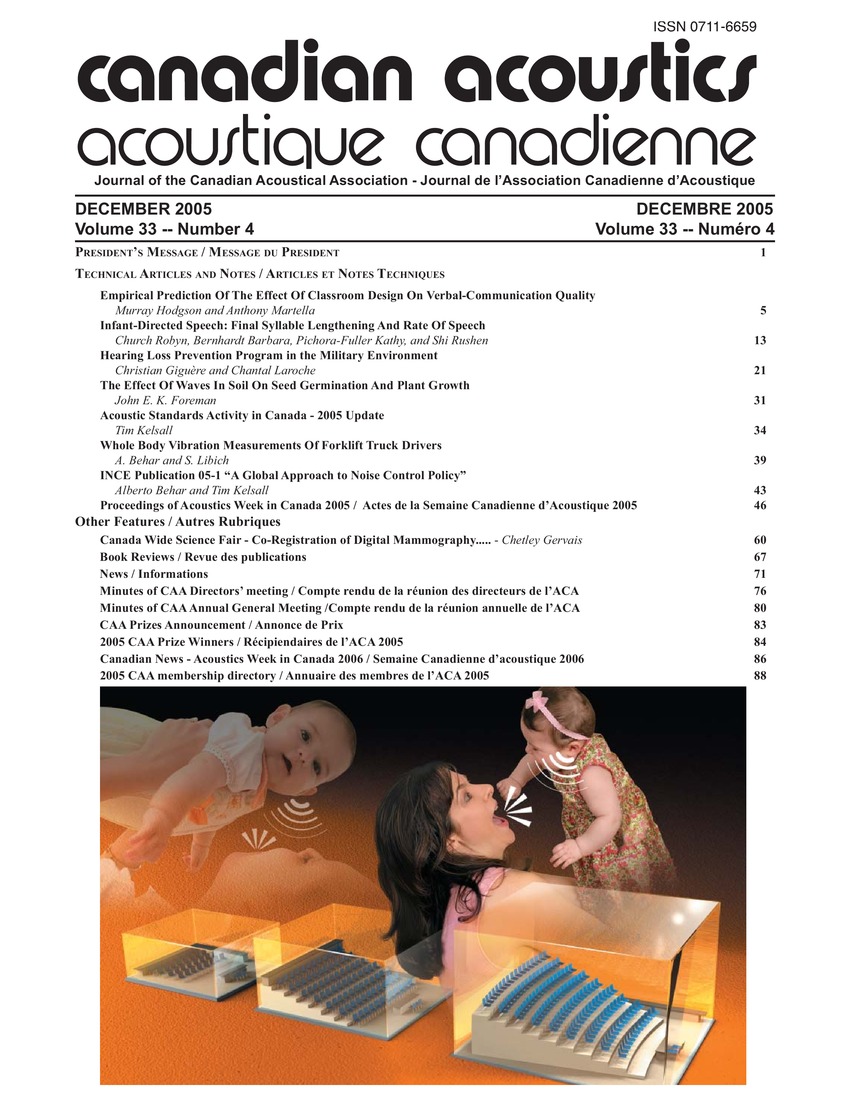
Fichiers supplémentaires
Publié-e
Comment citer
Numéro
Rubrique
Licence
Author Licensing Addendum
This Licensing Addendum ("Addendum") is entered into between the undersigned Author(s) and Canadian Acoustics journal published by the Canadian Acoustical Association (hereinafter referred to as the "Publisher"). The Author(s) and the Publisher agree as follows:
-
Retained Rights: The Author(s) retain(s) the following rights:
- The right to reproduce, distribute, and publicly display the Work on the Author's personal website or the website of the Author's institution.
- The right to use the Work in the Author's teaching activities and presentations.
- The right to include the Work in a compilation for the Author's personal use, not for sale.
-
Grant of License: The Author(s) grant(s) to the Publisher a worldwide exclusive license to publish, reproduce, distribute, and display the Work in Canadian Acoustics and any other formats and media deemed appropriate by the Publisher.
-
Attribution: The Publisher agrees to include proper attribution to the Author(s) in all publications and reproductions of the Work.
-
No Conflict: This Addendum is intended to be in harmony with, and not in conflict with, the terms and conditions of the original agreement entered into between the Author(s) and the Publisher.
-
Copyright Clause: Copyright on articles is held by the Author(s). The corresponding Author has the right to grant on behalf of all Authors and does grant on behalf of all Authors, a worldwide exclusive license to the Publisher and its licensees in perpetuity, in all forms, formats, and media (whether known now or created in the future), including but not limited to the rights to publish, reproduce, distribute, display, store, translate, create adaptations, reprints, include within collections, and create summaries, extracts, and/or abstracts of the Contribution.