
Shape Optimization of Reactive Mufflers Using Threshold Acceptance and FEM Methods
Mots-clés :
silencieux réactifs, algorithme d’optimisation, méthode de transfert de matrices, puissance acoustiqueRésumé
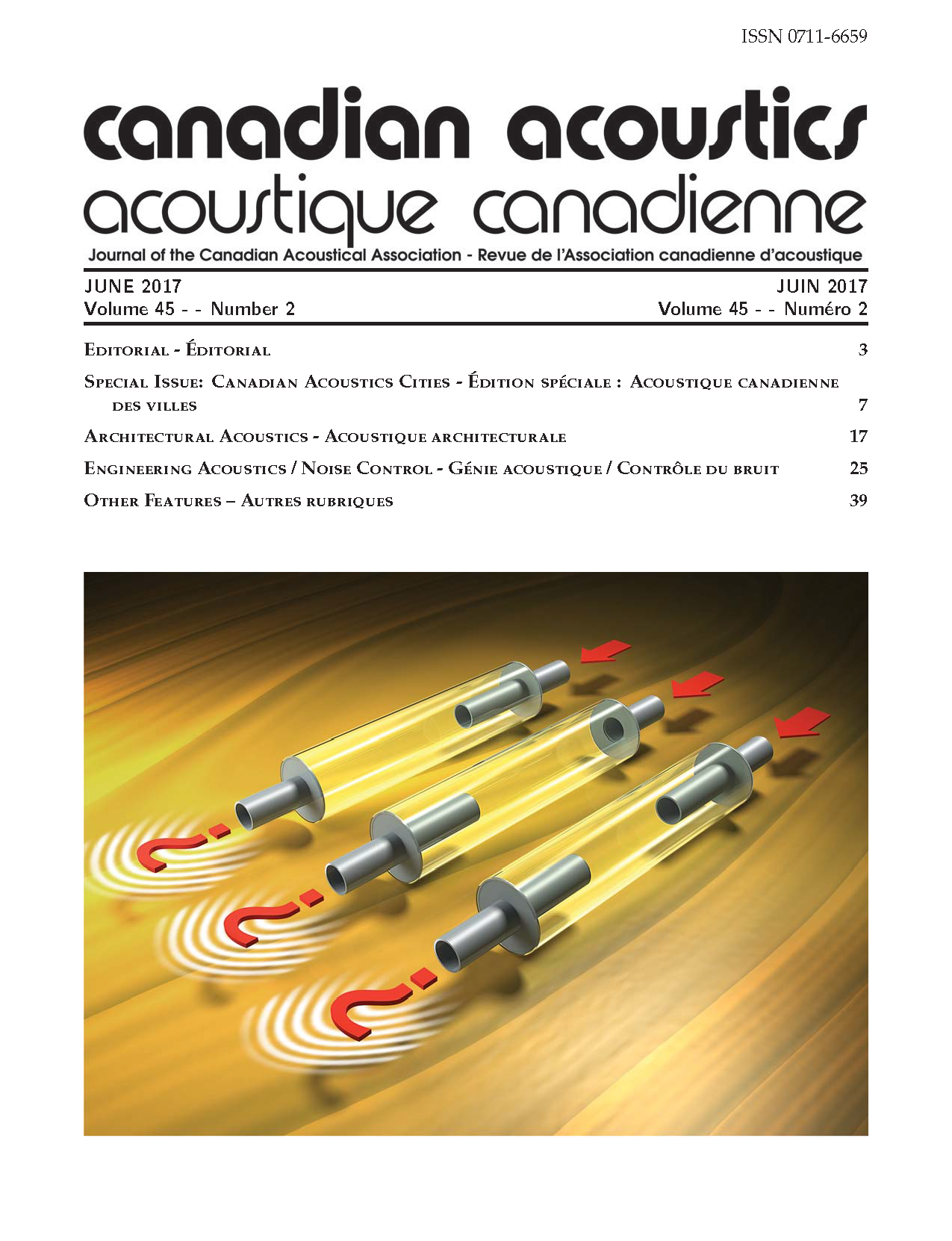
L'optimisation de forme des silencieux réactifs sous contrainte d'espace a une grande importance dans la conception d'environnements moins bruants. Dans ce travail, les performances acoustiques de trois types de silencieux soumis à un espace limité sont étudiées. Une analyse d'optimisation de forme est effectuée en utilisant un algorithme d’optimisation appelé Threshold Acceptance (TA). La conception optimale obtenue est analysée par la méthode des éléments finis (FEM : Finit Element Method). Cette approche numérique est basée sur la maximisation de la perte de transmission acoustique (STL : Sound Transmission Loss) à l'aide de la méthode de transfert de matrices (TMM : Transfer Matrix Method) qui est une méthode de modélisation basée sur le modèle de propagation d'onde plane. La solution en élément finis utilisée pour analyser la STL est basée sur la méthode de puissance acoustique, un code de calcul standard utilisé pour analyser en 3D l'atténuation acoustique des silencieux par la méthode FEM. La capacité acoustique des silencieux obtenus est évaluée en comparant la solution FEM à la méthode analytique. Les résultats montrent que la valeur maximale de la STL est précisément située à la tonalité ciblée. En outre, la performance acoustique du silencieux avec tube à l’entrée et à la sortie prolongée se trouve être supérieure aux autres types de silencieux. Par conséquent, cette approche fournit un schéma rapide pour l'optimisation de la forme des silencieux réactifs.
Fichiers supplémentaires
Publié-e
Comment citer
Numéro
Rubrique
Licence
Author Licensing Addendum
This Licensing Addendum ("Addendum") is entered into between the undersigned Author(s) and Canadian Acoustics journal published by the Canadian Acoustical Association (hereinafter referred to as the "Publisher"). The Author(s) and the Publisher agree as follows:
-
Retained Rights: The Author(s) retain(s) the following rights:
- The right to reproduce, distribute, and publicly display the Work on the Author's personal website or the website of the Author's institution.
- The right to use the Work in the Author's teaching activities and presentations.
- The right to include the Work in a compilation for the Author's personal use, not for sale.
-
Grant of License: The Author(s) grant(s) to the Publisher a worldwide exclusive license to publish, reproduce, distribute, and display the Work in Canadian Acoustics and any other formats and media deemed appropriate by the Publisher.
-
Attribution: The Publisher agrees to include proper attribution to the Author(s) in all publications and reproductions of the Work.
-
No Conflict: This Addendum is intended to be in harmony with, and not in conflict with, the terms and conditions of the original agreement entered into between the Author(s) and the Publisher.
-
Copyright Clause: Copyright on articles is held by the Author(s). The corresponding Author has the right to grant on behalf of all Authors and does grant on behalf of all Authors, a worldwide exclusive license to the Publisher and its licensees in perpetuity, in all forms, formats, and media (whether known now or created in the future), including but not limited to the rights to publish, reproduce, distribute, display, store, translate, create adaptations, reprints, include within collections, and create summaries, extracts, and/or abstracts of the Contribution.