
Méthode de mesures terrain de l'atténuation F-MIRE de protecteurs auditifs durant un quart de travail
Keywords:
Acoustic fields, Acoustics, Electric breakdown, Electric field measurement, Electric measuring instruments, Employment, Heat pump systems, Human engineering, Industrial economics, Pressure, Standards, (p, p, t) measurements, Different types, Field measurements, Field studies, Hearing protection devices (HPD), In order, In-field, Industrial noise, measurement methods, Noise attenuation, Simultaneous measurements, Sound fields, Sound pressures, Standardized testing, time signals, Work environmentsAbstract
Nowadays, hearing protection devices (HPD) are widely used to protect workers against industrial noise, however, a question worth examining is: "Is the worker truly provided with, at all times, protection that is as effective as what the manufacturer is advertising, based on standardized testing?" It is a commonly known and well documented fact that compared to values obtained from various existing field studies laboratory-measured noise attenuation values overestimate the actual protection being provided to workers. Too few studies are available on this topic, and the issues concerning HPD field measurement are still far from being resolved. Even if several field measurement methods have been developed, none has succeeded in being recognized as a standard. Therefore, the need for a new field measurement method, one which could become a recognized reference, is as relevant as ever. This paper presents a new field measurement method developed to quantify the in-field attenuation HPDs provide to workers. This method is designed to take ongoing measurements during a complete work shift (8 hours) and enable the measurement of the actual attenuation being provided to the worker in his work environment, for different types and levels of industrial noise. The measurement method is based on the F-MIRE protocol using a miniature double microphone that allows for simultaneous measurement of the sound pressure inside the protector and the sound field surrounding the worker. The time signals recorded are then analyzed in order to determine the overall protection, and also, to assess performance over time. Results from preliminary measurements obtained from factory workers are presented in order to fully illustrate the range of analysis possibilities of this new field measurement method.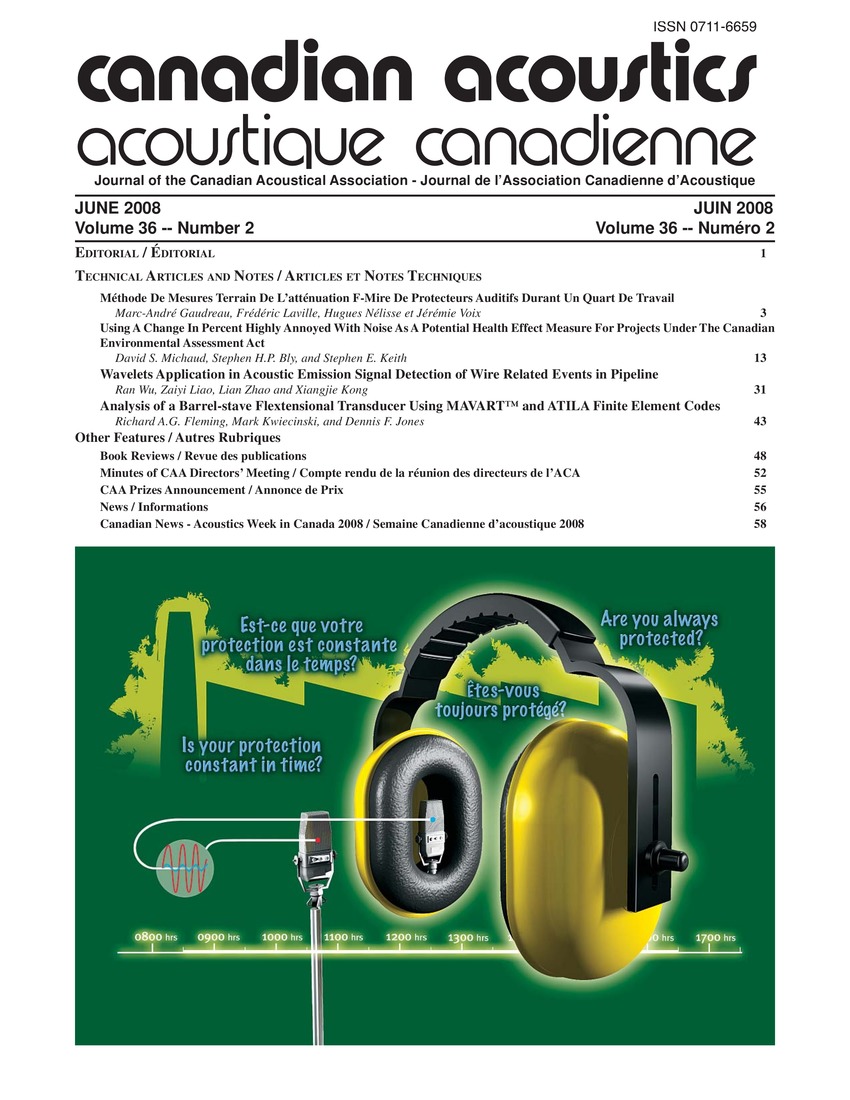
Additional Files
Published
How to Cite
Issue
Section
License
Author Licensing Addendum
This Licensing Addendum ("Addendum") is entered into between the undersigned Author(s) and Canadian Acoustics journal published by the Canadian Acoustical Association (hereinafter referred to as the "Publisher"). The Author(s) and the Publisher agree as follows:
-
Retained Rights: The Author(s) retain(s) the following rights:
- The right to reproduce, distribute, and publicly display the Work on the Author's personal website or the website of the Author's institution.
- The right to use the Work in the Author's teaching activities and presentations.
- The right to include the Work in a compilation for the Author's personal use, not for sale.
-
Grant of License: The Author(s) grant(s) to the Publisher a worldwide exclusive license to publish, reproduce, distribute, and display the Work in Canadian Acoustics and any other formats and media deemed appropriate by the Publisher.
-
Attribution: The Publisher agrees to include proper attribution to the Author(s) in all publications and reproductions of the Work.
-
No Conflict: This Addendum is intended to be in harmony with, and not in conflict with, the terms and conditions of the original agreement entered into between the Author(s) and the Publisher.
-
Copyright Clause: Copyright on articles is held by the Author(s). The corresponding Author has the right to grant on behalf of all Authors and does grant on behalf of all Authors, a worldwide exclusive license to the Publisher and its licensees in perpetuity, in all forms, formats, and media (whether known now or created in the future), including but not limited to the rights to publish, reproduce, distribute, display, store, translate, create adaptations, reprints, include within collections, and create summaries, extracts, and/or abstracts of the Contribution.