Méthode de mesures terrain de l'atténuation F-MIRE de protecteurs auditifs durant un quart de travail
Mots-clés :
Acoustic fields, Acoustics, Electric breakdown, Electric field measurement, Electric measuring instruments, Employment, Heat pump systems, Human engineering, Industrial economics, Pressure, Standards, (p, p, t) measurements, Different types, Field measurements, Field studies, Hearing protection devices (HPD), In order, In-field, Industrial noise, measurement methods, Noise attenuation, Simultaneous measurements, Sound fields, Sound pressures, Standardized testing, time signals, Work environmentsRésumé
L’usage des protecteurs auditifs est répandu comme moyen de protéger les travailleurs en milieu bruyant, mais, une question quant à leur usage mérite d’être posée : « Est-ce que le travailleur bénéficie en tout temps d’une protection aussi efficace que celle annoncée lors des mesures normalisées? ». Il est connu et accepté que la certification des protecteurs auditifs, en comparaison avec les différentes études « terrain » disponibles, surévalue l’atténuation réelle obtenue par les travailleurs. Trop peu d’études traitant de ce sujet sont disponibles et la problématique des mesures « terrain » de l’atténuation, malgré ces données, reste entière à ce jour. Même si plusieurs méthodes de mesures ont été développées, aucune n’a encore réussi à s’imposer pour devenir un standard reconnu et le besoin de développement d’une méthode de mesures « terrain » qui pourrait s’imposer comme référence en la matière est encore bien actuel.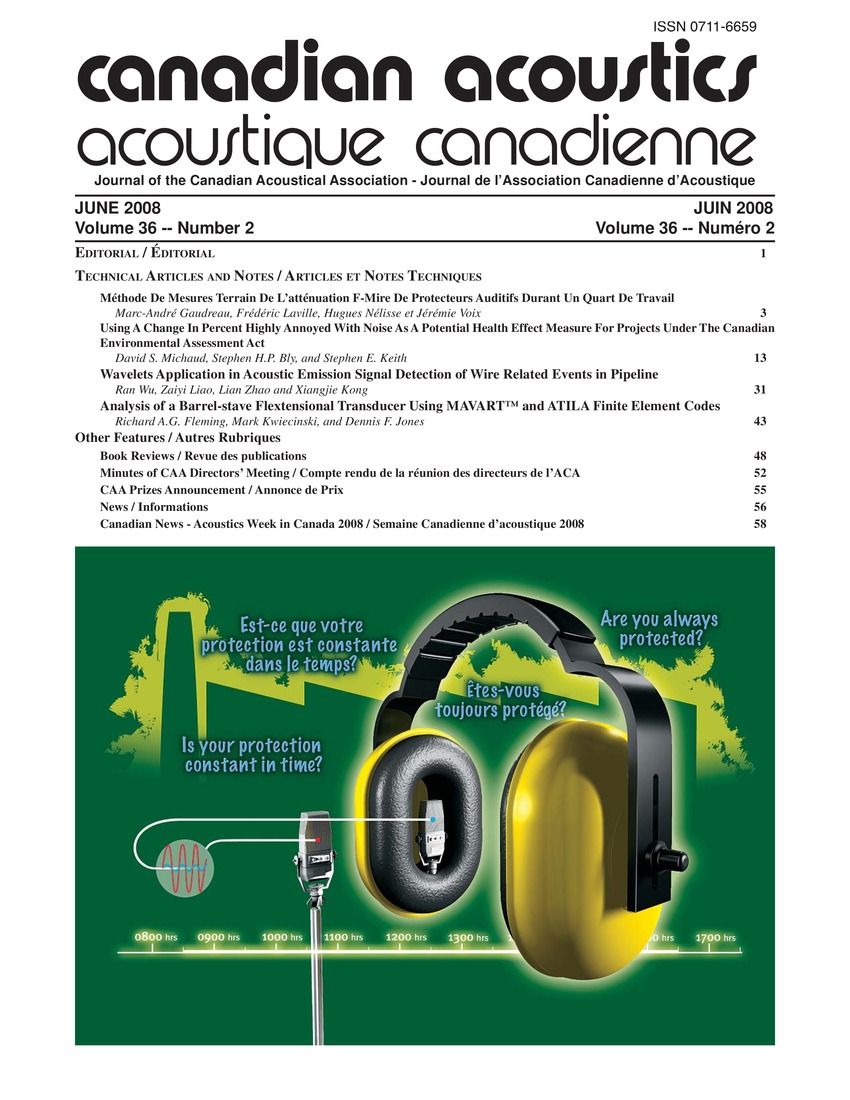
Fichiers supplémentaires
Publié-e
Comment citer
Numéro
Rubrique
Licence
Author Licensing Addendum
This Licensing Addendum ("Addendum") is entered into between the undersigned Author(s) and Canadian Acoustics journal published by the Canadian Acoustical Association (hereinafter referred to as the "Publisher"). The Author(s) and the Publisher agree as follows:
-
Retained Rights: The Author(s) retain(s) the following rights:
- The right to reproduce, distribute, and publicly display the Work on the Author's personal website or the website of the Author's institution.
- The right to use the Work in the Author's teaching activities and presentations.
- The right to include the Work in a compilation for the Author's personal use, not for sale.
-
Grant of License: The Author(s) grant(s) to the Publisher a worldwide exclusive license to publish, reproduce, distribute, and display the Work in Canadian Acoustics and any other formats and media deemed appropriate by the Publisher.
-
Attribution: The Publisher agrees to include proper attribution to the Author(s) in all publications and reproductions of the Work.
-
No Conflict: This Addendum is intended to be in harmony with, and not in conflict with, the terms and conditions of the original agreement entered into between the Author(s) and the Publisher.
-
Copyright Clause: Copyright on articles is held by the Author(s). The corresponding Author has the right to grant on behalf of all Authors and does grant on behalf of all Authors, a worldwide exclusive license to the Publisher and its licensees in perpetuity, in all forms, formats, and media (whether known now or created in the future), including but not limited to the rights to publish, reproduce, distribute, display, store, translate, create adaptations, reprints, include within collections, and create summaries, extracts, and/or abstracts of the Contribution.