
Turbulent boundary layer induced noise and vibration of a multi-panel walled acoustic enclosure
Keywords:
Acoustic noise measurement, Acoustic wave transmission, Acoustics, Enclosures, Accurate prediction, Acoustic enclosure, Analytical method, Analytical predictions, Cabin interior, Cabin noise, Flexible wall, Induced noise, Noise predictions, Real-life applications, Rigid wall, Simple structures, Sound pressure level, Sound pressures, Turbulent boundary layersAbstract
Flow-induced noise in aircraft cabins can be predicted through analytical models or numerical methods. To date, analytical methods have been used for simple structures and cabins, where usually a single panel is vibrating due to the flow excitation, and coupled with an acoustic enclosure. The present work investigates the analytical prediction of turbulent boundary layer induced noise and vibration of a multi-panel system. The objective is to investigate the coupling between individual panels and the acoustic enclosure. Each panel is coupled with the acoustic enclosure, which consists of a large rectangular room, with five rigid walls and one flexible wall. The properties of the panels and acoustic enclosure represent a typical fuselage skin panel and a cabin section, respectively. It is shown that identical panels located at different positions have dissimilar contributions to the cabin interior noise, showing that the panel position is an important variable for the accurate prediction and suppression of cabin noise. Analytical predictions were obtained for both the space-averaged interior sound pressure level and local interior sound pressure level. The space-averaged sound pressure level is usually accepted to provide the necessary information for the noise prediction; however, in some real life applications, the local sound pressure may also be desirable.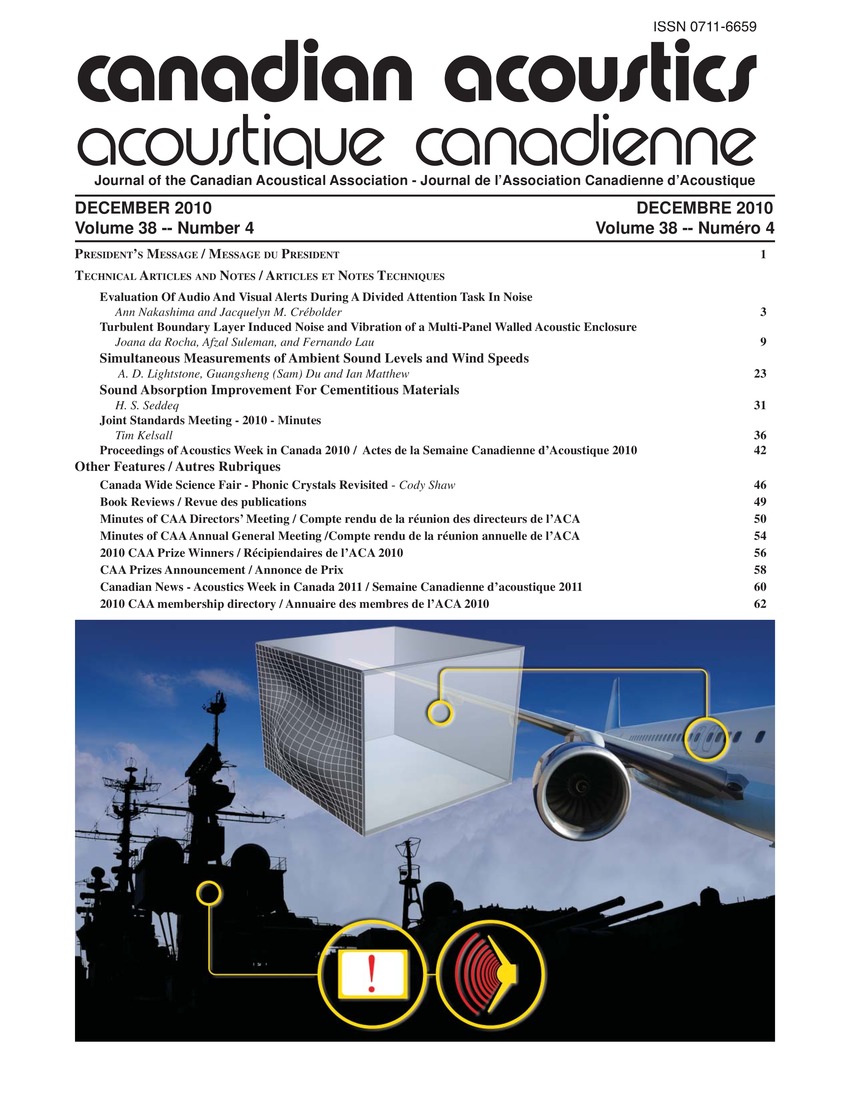
Additional Files
Published
How to Cite
Issue
Section
License
Author Licensing Addendum
This Licensing Addendum ("Addendum") is entered into between the undersigned Author(s) and Canadian Acoustics journal published by the Canadian Acoustical Association (hereinafter referred to as the "Publisher"). The Author(s) and the Publisher agree as follows:
-
Retained Rights: The Author(s) retain(s) the following rights:
- The right to reproduce, distribute, and publicly display the Work on the Author's personal website or the website of the Author's institution.
- The right to use the Work in the Author's teaching activities and presentations.
- The right to include the Work in a compilation for the Author's personal use, not for sale.
-
Grant of License: The Author(s) grant(s) to the Publisher a worldwide exclusive license to publish, reproduce, distribute, and display the Work in Canadian Acoustics and any other formats and media deemed appropriate by the Publisher.
-
Attribution: The Publisher agrees to include proper attribution to the Author(s) in all publications and reproductions of the Work.
-
No Conflict: This Addendum is intended to be in harmony with, and not in conflict with, the terms and conditions of the original agreement entered into between the Author(s) and the Publisher.
-
Copyright Clause: Copyright on articles is held by the Author(s). The corresponding Author has the right to grant on behalf of all Authors and does grant on behalf of all Authors, a worldwide exclusive license to the Publisher and its licensees in perpetuity, in all forms, formats, and media (whether known now or created in the future), including but not limited to the rights to publish, reproduce, distribute, display, store, translate, create adaptations, reprints, include within collections, and create summaries, extracts, and/or abstracts of the Contribution.