
Estimating Torpedo range using multi-path signals and fast orthogonal search techniques
Mots-clés :
Computer simulation, MATLAB, Range finders, Spectrum analysis, Torpedoes, Fast orthogonal search techniques, Surface-reflection signals, Torpedo Detection Algorithm (TDA), Torpedo range estimation algorithmRésumé
Cet article présente un algorithme d’estimation de la portée d’une torpille qui a été principalement développé à l’aide de MATLAB. L’algorithme de détection de torpille (ADT) utilise l’algorithme de recherche orthogonale rapide FOS qui permet une l’analyse spectrale de haute résolution pour détecter les signaux adjacents provenant des retours de signaux directs et des réflexions de surfaces. Lorsqu’un signal direct et un signal réfléchi sont décelés, une alerte automatique est déclenchée pour indiquer la détection possible d’une torpille. Par simulation, l’existence d’une torpille et sa portée sont évaluées pour un rayon d’opération variant de 5000 à 750 mètres du récepteur. Des expressions trigonométriques simples sont utilisées pour estimer la portée de la torpille en se basant sur les deux fréquences estimées par l’algorithme FOS et sur de l’information connue au préalable sur la vitesse et la profondeur de la torpille. L’article présente les portées prédites et exactes obtenues par simulation pour une torpille s’approchant de 5000 à 750 mètres.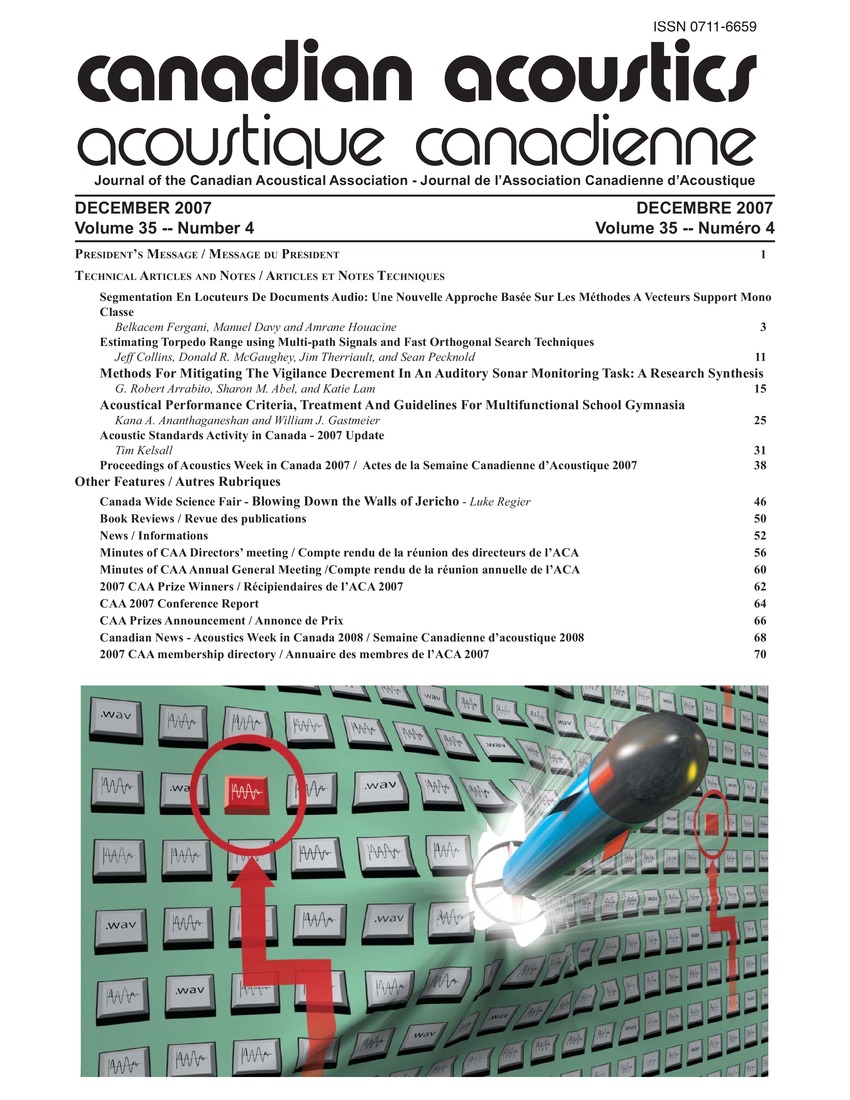
Fichiers supplémentaires
Publié-e
Comment citer
Numéro
Rubrique
Licence
Author Licensing Addendum
This Licensing Addendum ("Addendum") is entered into between the undersigned Author(s) and Canadian Acoustics journal published by the Canadian Acoustical Association (hereinafter referred to as the "Publisher"). The Author(s) and the Publisher agree as follows:
-
Retained Rights: The Author(s) retain(s) the following rights:
- The right to reproduce, distribute, and publicly display the Work on the Author's personal website or the website of the Author's institution.
- The right to use the Work in the Author's teaching activities and presentations.
- The right to include the Work in a compilation for the Author's personal use, not for sale.
-
Grant of License: The Author(s) grant(s) to the Publisher a worldwide exclusive license to publish, reproduce, distribute, and display the Work in Canadian Acoustics and any other formats and media deemed appropriate by the Publisher.
-
Attribution: The Publisher agrees to include proper attribution to the Author(s) in all publications and reproductions of the Work.
-
No Conflict: This Addendum is intended to be in harmony with, and not in conflict with, the terms and conditions of the original agreement entered into between the Author(s) and the Publisher.
-
Copyright Clause: Copyright on articles is held by the Author(s). The corresponding Author has the right to grant on behalf of all Authors and does grant on behalf of all Authors, a worldwide exclusive license to the Publisher and its licensees in perpetuity, in all forms, formats, and media (whether known now or created in the future), including but not limited to the rights to publish, reproduce, distribute, display, store, translate, create adaptations, reprints, include within collections, and create summaries, extracts, and/or abstracts of the Contribution.