
Using a change in percent highly annoyed with noise as a potential health effect measure for projects under the Canadian Environmental Assessment Act
Keywords:
Environmental impact assessments, Health, Noise pollution, Photoacoustic effect, Public policy, Research, Standards, (e, 3e) process, Adverse health effects, cause effect, Community noise, Environmental assessment (ES), European, expert advice, Guidance documents, health effects, health impacts, International standard (IS), Long-term changes, noise impacts, Noise mitigation, Policy setting, potential health, Public health, Quantitative criteria, Scientific researches, Socio acousticAbstract
Health Canada is in the process of developing a document, Guidance for Environmental Assessment-Health Impacts of Noise (Guidance) on how to assess noise impacts in environmental assessments. The guidance document is needed to assist Health Canada in providing consistent expert advice on the health effects of project noise, when requested under the Canadian Environmental Assessment Act (CEAA). Differences exist between various noise mitigation criteria used in environmental assessments from across Canada. Therefore, the first step for Health Canada to provide consistent advice is to establish quantitative criteria for adverse health effects as a function of project-related long-term changes in noise. The criteria should be based on scientific research that has demonstrated a reasonable cause-effect association between an adverse impact on public health and well-being and community noise exposure. This paper shows that: (i) there is a substantial amount of community-based social and socio-acoustic research and (ii) precedent from U.S., European and International standard and policy setting bodies, to justify the use of a change in percentage highly annoyed with noise (%HAn) as one of the health endpoints for an environmental assessment. Furthermore, viewing high noise annoyance as an adverse health effect is consistent with Health Canada's definition of "health". This paper also shows that %HAn is preferable as a long term endpoint than the use of noise complaints. To add to this, there have been recent nation-wide Canadian social surveys on high noise annoyance that further support its use as an adverse health effect to be considered in Canadian environmental assessments.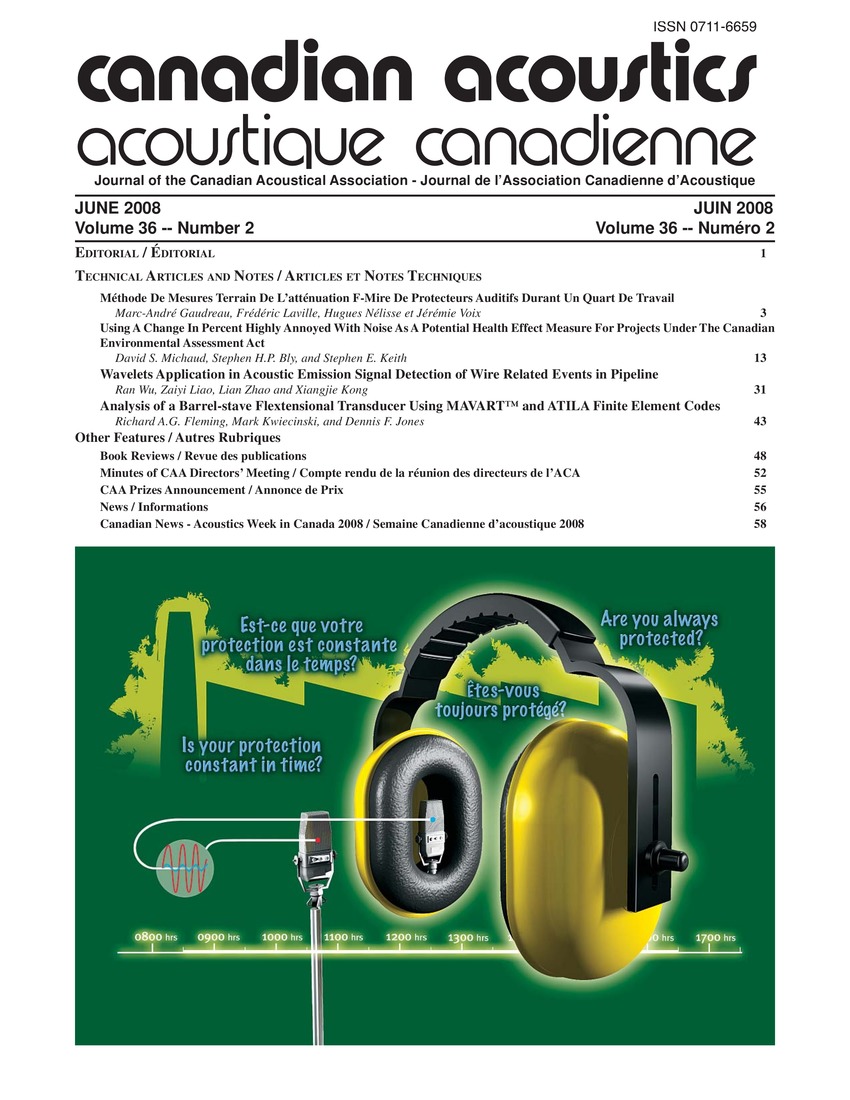
Additional Files
Published
How to Cite
Issue
Section
License
Author Licensing Addendum
This Licensing Addendum ("Addendum") is entered into between the undersigned Author(s) and Canadian Acoustics journal published by the Canadian Acoustical Association (hereinafter referred to as the "Publisher"). The Author(s) and the Publisher agree as follows:
-
Retained Rights: The Author(s) retain(s) the following rights:
- The right to reproduce, distribute, and publicly display the Work on the Author's personal website or the website of the Author's institution.
- The right to use the Work in the Author's teaching activities and presentations.
- The right to include the Work in a compilation for the Author's personal use, not for sale.
-
Grant of License: The Author(s) grant(s) to the Publisher a worldwide exclusive license to publish, reproduce, distribute, and display the Work in Canadian Acoustics and any other formats and media deemed appropriate by the Publisher.
-
Attribution: The Publisher agrees to include proper attribution to the Author(s) in all publications and reproductions of the Work.
-
No Conflict: This Addendum is intended to be in harmony with, and not in conflict with, the terms and conditions of the original agreement entered into between the Author(s) and the Publisher.
-
Copyright Clause: Copyright on articles is held by the Author(s). The corresponding Author has the right to grant on behalf of all Authors and does grant on behalf of all Authors, a worldwide exclusive license to the Publisher and its licensees in perpetuity, in all forms, formats, and media (whether known now or created in the future), including but not limited to the rights to publish, reproduce, distribute, display, store, translate, create adaptations, reprints, include within collections, and create summaries, extracts, and/or abstracts of the Contribution.