
Laboratory performance of the single-sided E-A-R® combat arms hearing protective earplug
Mots-clés :
Acoustic generators, White noise, Centre frequency, Error types, Hearing loss, Hearing protection, Hearing threshold, Horizontal planes, Key factors, Laboratory performance, Mode of operations, Modes of operation, Noise bands, Normal hearing, Sound attenuation, Sound source identificationRésumé
Le but de cet article est de comparer l’effet du port de bouchons conventionnels à celui de bouchons passifs avec atténuation dépendante du niveau acoustique sur l’audition et l’identification de sources sonores dans le plan horizontal dans le silence. Un protecteur permettant ces deux modes d’opération a été étudié auprès de dix hommes et dix femmes ayant une audition normale. Chaque individu a été évalué sans protection auditive et avec port binaural du protecteur dans chacun des deux modes. Les seuils auditifs en champ libre ont été mesurés pour des bandes de bruits tiers d’octave centrées sur des fréquences entrent 250 Hz et 8000 Hz, ainsi que la capacité à discriminer huit haut-parleurs placés à un mètre autour des participants. Le stimulus était d’une durée de 300 ms et était présenté à 75 dB SPL. Le degré d’atténuation a été déduit à partir des seuils auditifs. En mode conventionnel, des seuils moyens entre 36.2 et 53.3 dB SPL ont été obtenus, équivalent à une perte auditive de degré léger. En mode avec atténuation dépendante du niveau, les seuils auditifs n’ont pas dépassés 37.9 dB SPL. Les valeurs moyennes d’atténuation obtenues étaient en général similaires aux données fournies par le fabricant. Aucun effet du genre n’a été observé. Comparativement à la condition sans protection auditive, le pourcentage d’identifications correctes de la source sonore avec port du protecteur a chuté par 40% en mode conventionnel et par 20% en mode avec atténuation dépendante du niveau. Le degré d’atténuation semble donc être un facteur clé pour expliquer les résultats obtenus. Par contre, une analyse du type d’erreurs commises en mode avec atténuation dépendante du niveau a démontré un biais pour des réponses vers l’avant similaire à celui obtenu antérieurement avec un protecteur incorporant des microphones externes pour améliorer la communication.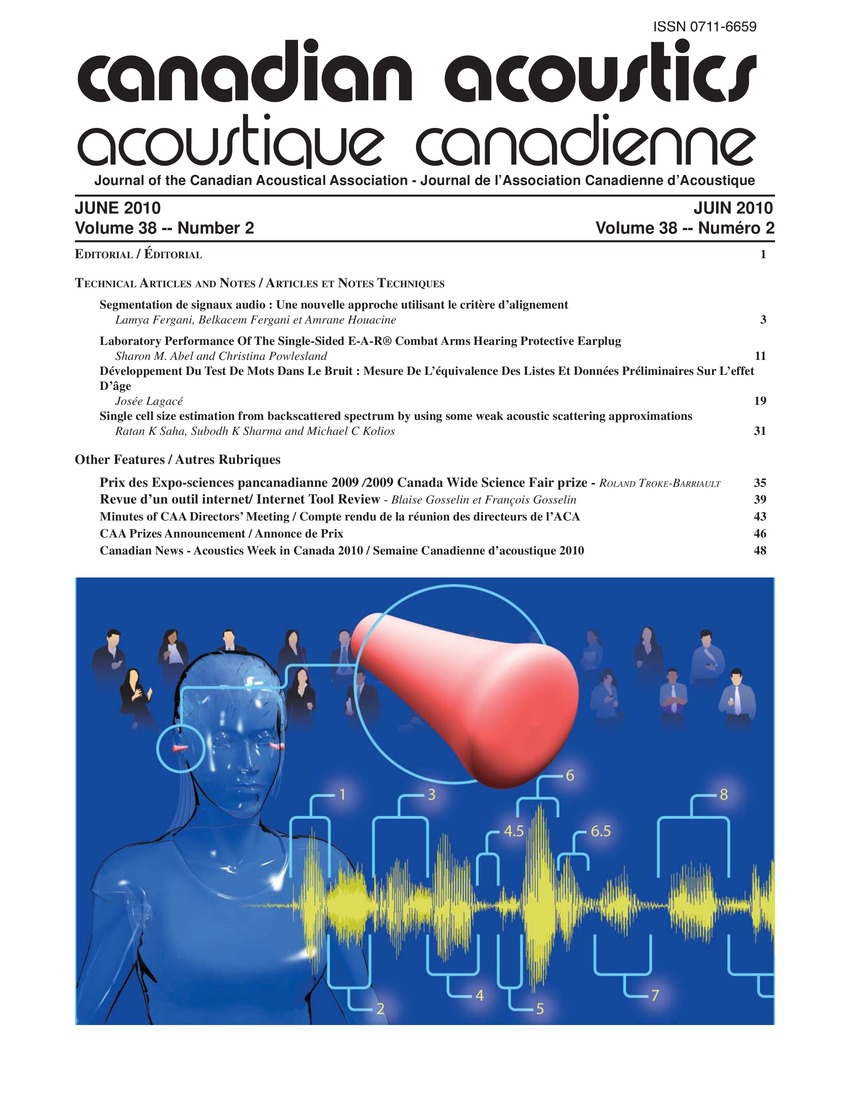
Fichiers supplémentaires
Publié-e
Comment citer
Numéro
Rubrique
Licence
Author Licensing Addendum
This Licensing Addendum ("Addendum") is entered into between the undersigned Author(s) and Canadian Acoustics journal published by the Canadian Acoustical Association (hereinafter referred to as the "Publisher"). The Author(s) and the Publisher agree as follows:
-
Retained Rights: The Author(s) retain(s) the following rights:
- The right to reproduce, distribute, and publicly display the Work on the Author's personal website or the website of the Author's institution.
- The right to use the Work in the Author's teaching activities and presentations.
- The right to include the Work in a compilation for the Author's personal use, not for sale.
-
Grant of License: The Author(s) grant(s) to the Publisher a worldwide exclusive license to publish, reproduce, distribute, and display the Work in Canadian Acoustics and any other formats and media deemed appropriate by the Publisher.
-
Attribution: The Publisher agrees to include proper attribution to the Author(s) in all publications and reproductions of the Work.
-
No Conflict: This Addendum is intended to be in harmony with, and not in conflict with, the terms and conditions of the original agreement entered into between the Author(s) and the Publisher.
-
Copyright Clause: Copyright on articles is held by the Author(s). The corresponding Author has the right to grant on behalf of all Authors and does grant on behalf of all Authors, a worldwide exclusive license to the Publisher and its licensees in perpetuity, in all forms, formats, and media (whether known now or created in the future), including but not limited to the rights to publish, reproduce, distribute, display, store, translate, create adaptations, reprints, include within collections, and create summaries, extracts, and/or abstracts of the Contribution.