
Geo-acoustic models for propagation modelling in shallow water
Mots-clés :
acoustic wave propagation, physics computing, seismic waves, underwater sound, geoacoustic models, acoustic propagation, guided wave phenomenon, subkilohertz frequencies, propagation modelling, shallow water, sea surface, seabed, computer modelling, sound speed, density, attenuation, layer thicknesses, sub bottom vertical reflection profiles, sediment types, seismic refraction experiments, Scotian Shelf, English ChannelRésumé
La propagation des sons en eau peu profonde est considérée comme un phénomène d'onde guidée, la surface de la mer et le fond marin constituant les limites. Aux fréquences inférieures au kilohertz, les propriétés acoustiques du fond marin jusqu'à une profondeur de plusieurs longueurs d'ondes peuvent avoir une grande influence sur la propagation. La modélisation par ordinateur de la propagation nécessite l'estimation de paramètres comme la vitesse du son, la densité, l'atténuation et 1'épaisseur des couches, qui portent collectivement le nom de modèle géoacoustique du fond marin. La mesure directe de ces paramètres est difficile et on doit mettre au point des méthodes permettant de déduire ces valeurs d'autres expériences souvent basées sur 1'application de techniques acoustiques. Au CRDA nous avons adopté une méthode visant à déterminer séparément le plus grand nombre possible de ces valeurs avant d'ajuster les valeurs des paramètres moins bien connus à 1'intérieur de limites raisonnables pour faire correspondre les résultats expérimentaux à la théorie. A cette fin nous avons utilisé des profils de reflection sous le fond pour déterminer les types de sédiments et leur épaisseur, des expériences de sismique réfraction à petite et à grande échelle afin d'estimer les vitesses du son et le traitement des données de réflection sous le fond afin d'estimer l'atténuation de 1'intensité. Des exemples de modèles géo-acoustiques et des comparaisons avec les résultats expérimentaux sont présentés pour des emplacements en eau peu profonde de la plateforme néo-écossaise et des approches sud-ouest de la Manche.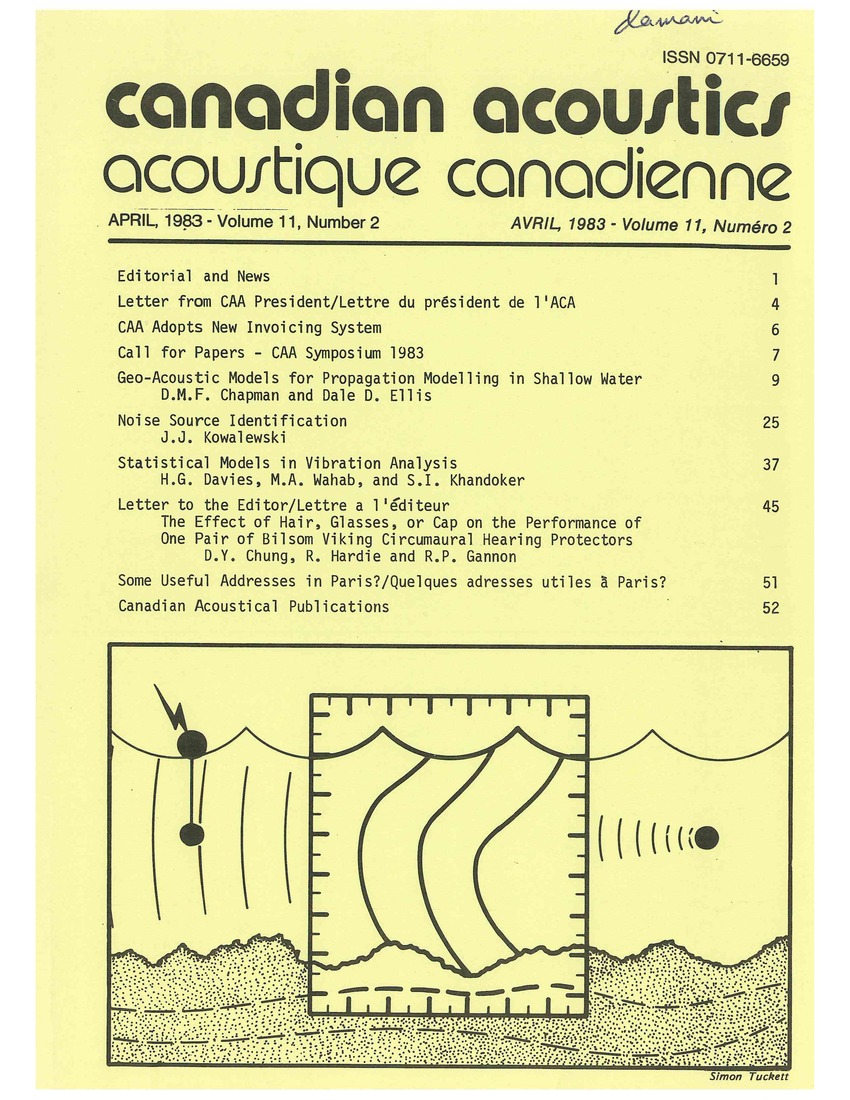
Fichiers supplémentaires
Publié-e
Comment citer
Numéro
Rubrique
Licence
Author Licensing Addendum
This Licensing Addendum ("Addendum") is entered into between the undersigned Author(s) and Canadian Acoustics journal published by the Canadian Acoustical Association (hereinafter referred to as the "Publisher"). The Author(s) and the Publisher agree as follows:
-
Retained Rights: The Author(s) retain(s) the following rights:
- The right to reproduce, distribute, and publicly display the Work on the Author's personal website or the website of the Author's institution.
- The right to use the Work in the Author's teaching activities and presentations.
- The right to include the Work in a compilation for the Author's personal use, not for sale.
-
Grant of License: The Author(s) grant(s) to the Publisher a worldwide exclusive license to publish, reproduce, distribute, and display the Work in Canadian Acoustics and any other formats and media deemed appropriate by the Publisher.
-
Attribution: The Publisher agrees to include proper attribution to the Author(s) in all publications and reproductions of the Work.
-
No Conflict: This Addendum is intended to be in harmony with, and not in conflict with, the terms and conditions of the original agreement entered into between the Author(s) and the Publisher.
-
Copyright Clause: Copyright on articles is held by the Author(s). The corresponding Author has the right to grant on behalf of all Authors and does grant on behalf of all Authors, a worldwide exclusive license to the Publisher and its licensees in perpetuity, in all forms, formats, and media (whether known now or created in the future), including but not limited to the rights to publish, reproduce, distribute, display, store, translate, create adaptations, reprints, include within collections, and create summaries, extracts, and/or abstracts of the Contribution.